- Home
- Media Kit
- MediaJet
- Current Issue
- Past Issues
- Reprints (PDF)
- Photo Specifications (PDF)
- Contact Us
- PRIVACY POLICY
- TERMS OF USE
Loading

ONLINE

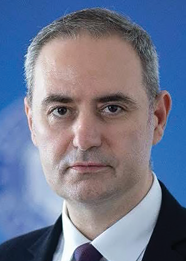
H.E. Alexandru Nazare
Open, Safe, And
Ready For Business
Editors’ Note
As of June 2025, Alexandru Nazare serves as the Minister of Finance of Romania, being responsible for managing the country’s public finances and economic policy. Nazare oversees the formulation and implementation of Romania’s fiscal, budgetary, and financial strategies, ensuring stability, transparency, and sustainability in accordance with domestic legislation and European Union regulations. He also represents Romania in its engagements with key international financial institutions and strategic partners, working to strengthen the country’s economic position and fiscal credibility. Prior to this role, in 2024, he was a prominent Member of the Board of Directors of the National Bank of Romania (NBR). As an NBR board member, he has contributed to strategic decisions on monetary policy, interest rates, and banking regulation, aiming to maintain the stability of the national currency and the resilience of Romania’s banking sector. He has also advocated for aligning Romania’s monetary policies with EU standards, promoting sustainable growth and sound fiscal management, and strengthening public confidence in the financial system amid global economic uncertainties. Between 2020 and 2024, Nazare served as a Senator, representing electoral district no. 31, Prahova. During this tenure, he focused on advancing economic reform and legislative initiatives to support fiscal responsibility, economic stability, and growth. He was an active member of the Senate’s economic and budgetary committees, where he contributed to the drafting of laws on financial regulation, public administration, and investment policy. His efforts emphasized transparency in public spending and the development of key strategic sectors such as energy and infrastructure, while reinforcing Romania’s economic resilience and integration with the European Union. At the end of 2020, Nazare was appointed Minister of Finance in the Cîtu Government, amid the economic challenges of the COVID-19 pandemic. He launched an economic recovery program focused on liberal principles, prudent fiscal management, and long-term sustainability. Together with the Cîtu Cabinet, he developed a budget strategy to restore fiscal balance and promote growth. On July 8, 2021, Nazare strongly opposed government procurement and fiscal procedures during the pandemic, concluding with his dismissal by Prime Minister Florin Cîtu. In 2020, Nazare achieved a significant milestone for Romania in his capacity as the Government’s Special Representative for the preparation and promotion of Romania’s candidacy to host the European Cybersecurity Industrial, Technology and Research Competence Centre. The Romanian team, led by Nazare, won the competition against six other candidate countries seeking to host the cybersecurity center – an EU body responsible for managing the Union’s investments in the field of cybersecurity. Prior to this, in December 2020, Nazare was re-elected to the Romanian Parliament as a Senator for Prahova County and in 2019 he served as an advisor at the Ministry of Transport, Infrastructure, and Communications, contributing to strategic and administrative initiatives within the ministry. Nazare began his career at the Ministry of European Integration as an adviser to Minister Anca Boagiu, contributing to Romania’s preparations for EU accession through policy coordination and strategic analysis. Academically, between 2015 and 2017 Nazare earned a Master’s degree in Public Administration from the Hertie School of Governance in Berlin. From 2002 to 2004, he pursued studies at the European College of Liberal Arts in Berlin, complementing his undergraduate education at the National School of Political and Administrative Studies (SNSPA) in Bucharest, where he studied political science from 2001 to 2005.
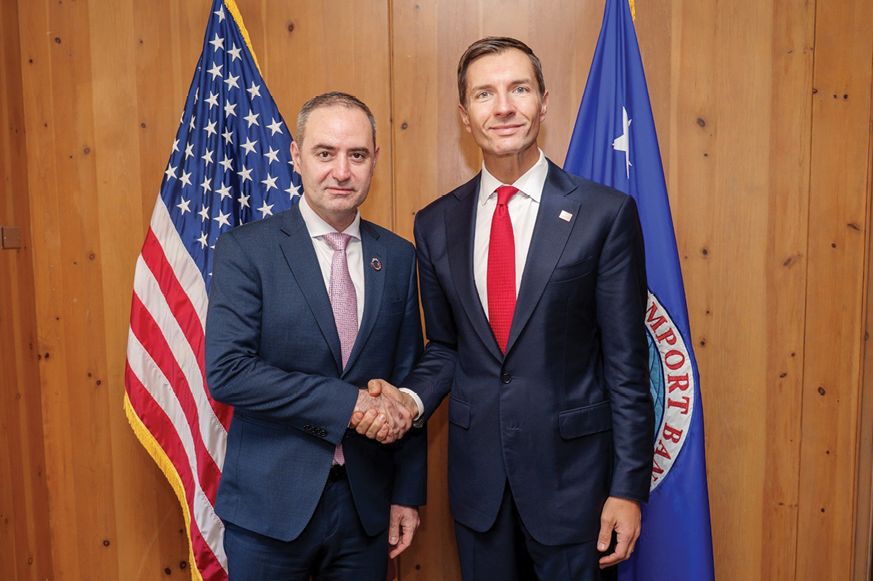
H.E. Alexandru Nazare and John Jovanovic, President and
Chairman,
Export-Import Bank of the United States
Romania’s investment climate is under scrutiny globally. How is the government reshaping the policy and regulatory environment to make the country more attractive for high-quality foreign and domestic investment?
Romania is transitioning from a period characterized by accumulated budgetary deficit to one of accelerated reshaping to reset the healthiness of our public finances. Our strategy is built on three pillars designed to offer predictability and efficiency. First, we are going through a process that aims to set the economy on a healthy foundation by equilibrating the balance between collection and public spending. We have not only broadened the tax base to eliminate the inequalities between taxpayers, but we are also leveling the playing field and reducing unfair competition from the grey economy. We are ensuring that fiscal consolidation acts as an enabler for growth, not a break. Secondly, we are prioritizing high-impact public investments funded through the EU Recovery and Resilience Facility (RRF), focusing on connectivity and productivity. Third, we are creating specific, stable frameworks for capital-intensive sectors – energy, infrastructure, and technology. Coupled with state aid schemes fully aligned with EU rules, we are offering incentives for profit reinvestment. A prime example is our new portfolio guarantee instrument via the Development Bank of Romania, which will mobilize $2 billion in SME financing between 2025 and 2027. Stability and predictability are the currencies we trade in to attract high-quality capital.
Fiscal consolidation remains a pressing requirement for Romania. How is the government striking the balance between stabilizing public finances and creating meaningful incentives for capital-intensive investment?
Fiscal consolidation is essential for safeguarding macroeconomic stability and investor confidence, but it must be calibrated to preserve long-term growth potential. We are striking this balance by shifting the weight of adjustment from tax hikes to expenditure efficiency and better collection. On the revenue side, the digital transformation of ANAF (National Agency for Fiscal Administration) is yielding results, reducing the VAT gap and bringing revenue to the surface. On the expenditure side, we have successfully slowed the growth rate of public spending – down to 9.9 percent in October 2025 compared to the previous year, with a significant reduction in personnel expenses.
Simultaneously, we protect the investment budget. By leveraging EU funds and sovereign financing instruments, we ensure that while the deficit narrows towards our 6 percent target for 2026, the flow of capital into infrastructure and private sector incentives remain robust. Stable public finances do not hinder investment; they enable it by lowering financing costs and risk premiums.
Romania is often seen as a rising economic hub in Central and Southeast Europe. What advantages do you believe Romania should promote more aggressively in the next 5–10 years to strengthen this regional leadership role?
Romania stands at the convergence of strategic logistics, energy independence, and human capital. First, our location on the Black Sea makes us the gateway for the Middle Corridor trade route linking Asia to Europe.
We are planning on modernizing the Port of Constanta and we are aggressively investing our transport infrastructure to serve as the logistical hub for the region and for the reconstruction of Ukraine.
Second, Energy Independence. Unlike many peers, Romania has a balanced energy mix – nuclear, hydro, gas, and renewables. The Neptun Deep gas project will make us a regional energy security provider.
Third, Human Capital. We have a highly skilled, multilingual workforce, particularly in STEM fields. By promoting these assets alongside our path toward OECD accession, Romania is positioning itself not just as a market, but as the stability anchor for Southeast Europe.
Major investment projects require diverse and sophisticated financing instruments. How is the government planning to combine public borrowing, sovereign funds, EU instruments, export–import agencies, blended finance and public–private partnerships to mobilize capital?
We are moving beyond simple sovereign borrowing toward a sophisticated “blended finance” ecosystem. We use public borrowing to secure the baseline for strategic needs, but the multiplier effect comes from elsewhere. We are maximizing EU instruments and the National Recovery and Resilience Plan (NRRP) to de-risk long-term investments in energy and digitalization. For 2026, more than $11.8 billion will enter the Romanian economy through this instrument. Complementary, the end of NRRP will mean the mobilization of SAFE program funding, which will offer us the possibility to invest more than $18.8 billion in the defense industry in the following years.
Crucially, we are deepening our collaboration with export-import agencies, such as EximBank and US Exim, to facilitate large-scale strategic projects. Through such collaborations, we combine public and private capital, reducing risks for investors and facilitating strategic projects. Regarding public–private partnerships (PPP), these will represent a major source of growth for Romania. Recently, we hosted a regional PPP meeting at the Palace of Parliament, together with the U.S. Department of Commerce – CLDP, where over 40 experts from 11 countries engaged in practical discussions on developing infrastructure projects through PPPs. This allowed the import of American know-how, concrete progress on real projects, and a renewed commitment to professionalizing administration, attracting private capital, and strengthening the partnership with the U.S. Investor interest is stimulated through viable projects, and building a solid portfolio and institutional technical expertise remains a key priority.
Through this integrated approach, we aim to create a robust financing ecosystem that enables the implementation of priority projects in the economy, energy, infrastructure, and innovation, thereby consolidating medium- and long-term economic growth.
How do you envision Romania’s tax policy evolving?
The philosophy is stability over volatility. We are moving away from piecemeal changes toward a predictable code that simplifies compliance and reduces the administrative burden. The focus is on digitization as the primary driver of revenue, ensuring fairness by making sure everyone pays their share, rather than raising rates on those who already comply. This package also includes targeted economic recovery measures – incentives for strategic investments in technology and industry – to ensure that as we consolidate the budget, we do not suffocate the economy.
The global environment increasingly prioritizes transparency, anti-money-laundering compliance and secure capital flows. How is Romania enhancing cooperation with the U.S., EU, and other strategic partners to align regulations with international standards to attract global capital?
Transparency is the bedrock of trust. Romania is fully committed to the rigorous implementation of the EU’s Anti-Money Laundering (AML) package and is working closely with the Council of Europe’s MONEYVAL. Furthermore, our strategic partnership with the United States extends to financial integrity. We are enhancing the capabilities of our Financial Intelligence Unit (ONPCSB) and aligning our screening mechanisms for Foreign Direct Investment (FDI) to ensure that capital flows entering Romania are secure and do not pose strategic risks. This alignment is vital not just for security, but for our goal of OECD accession, which serves as the ultimate seal of approval for institutional investors.
Global economies are redefining supply chains through reshoring and friendshoring strategies. How is Romania positioning itself to attract U.S. and European companies seeking stable, secure and predictable production bases in the region?
Romania is the ideal candidate for “friendshoring.” We offer the stability of NATO and EU membership, combined with energy independence and a strategic location. We are positioning Romania as the industrial stronghold of the Eastern Flank. For U.S. and European companies decoupling from high-risk jurisdictions, Romania offers a secure legal framework, low energy costs relative to the region (thanks to our hydro and nuclear mix), and a skilled workforce. We are actively tailoring state aid packages to welcome production facilities in chips, defense, and automotive components, signaling that Romania is open, safe, and ready for business.
If you had to identify a single flagship priority for the next 12–18 months, one that would most significantly elevate Romania’s credibility and attractiveness in the eyes of investors, partners and global financial institutions, what would it be?
OECD accession. This is not merely a membership badge; it is the ultimate catalyst for structural reform. The accession process forces us to align our corporate governance, fiscal policies, and investment climate with the highest global standards. Achieving OECD membership will be the strongest possible signal to the global investment community that Romania has irreversibly matured into a developed, transparent, and predictable economy. It is the anchor that secures all our other achievements.